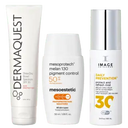
Sun protection is the most important step in your routine, every day, even when it's cloudy. UV radiation is the biggest cause of wrinkles, pigmentation and skin that loses firmness. SPF (sun protection factor) shows how well a product protects you against sunburn. In this collection you'll find day creams with SPF 30 and 50, mineral and tinted versions, and sprays to reapply.
What to look for in sun protection
-
SPF 30 or 50 with broad spectrum. Look for protection against both UVA and UVB. UVB causes sunburn, while UVA contributes to skin aging and passes through clouds and glass.
-
Chemical or mineral. Chemical filters absorb into the top layer of skin, while mineral filters (zinc oxide and titanium dioxide) stay as a particle on the skin. Mineral often suits sensitive skin better. If your skin reacts to your sunscreen, find out how to trace the cause.
-
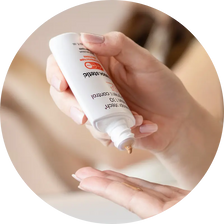
Use enough. Follow the two-finger rule: a line of product along the full length of your index and middle finger is enough for your face and neck. Your neck and décolleté need that same protection just as much. Applying too little gives you less protection than the number on the bottle promises.
-
Reapply. Every two hours in the sun, and after sweating or swimming.
-
Vitamin A and acids. If you use retinol or exfoliants, your skin becomes more sensitive to the sun. Adjust your routine for the warmer months accordingly.
How to build a routine
Morning
- Cleanse and apply your serum.
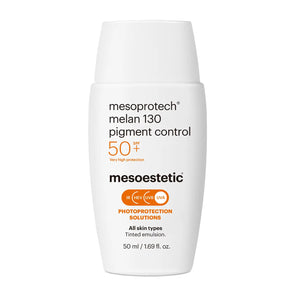
- Apply SPF as the last step. One example is a moisturizer with SPF 50 that contains zinc oxide, vitamin C and ectoin (an ingredient that protects skin against dehydration).
- Prefer something mineral and lightly tinted? Choose a mineral moisturizer with SPF 30 and 6% zinc oxide instead.
During the day and evening
- Reapply every two hours when you're outside. Over make-up, use a spray, such as the mesoestetic mesoprotech facial sun mist SPF50+.
- Cleanse thoroughly in the evening, so the SPF is fully removed from your skin.
- Follow with a calming or hydrating cream, especially after a day in the sun. Still got sunburn? Find out how to look after sunburnt skin. If the exposure came from a tanning bed, read up on what UV from a tanning bed does to your skin.
Not sure whether a mineral or chemical SPF suits you? Take our SkinQuiz, and we'll put together a routine with an SPF for your skin.
Advice from our skin therapist
In practice, we see that almost everyone applies too little, and only in summer. Most pigmentation and fine lines show up on spots that catch sun all year round: cheekbones, nose and hands.
Our advice: choose an SPF you actually like, because that's the one you'll apply every day. Use it as the last step in the morning, even in winter and behind a window. If a mole changes or a spot stays red, have it checked by your doctor.